- Lead Works & Flashing
Lead Works & Flashing
Hand-dressed lead work and flashing across Hampshire, Dorset and Surrey. Chimneys, valleys, abutments, dormers and skylights, all detailed properly in Code 4 and Code 5 lead by craftsmen who learnt the traditional way.
Why Lead Still Outperforms Everything Else
Wherever your roof meets something else, whether that’s a wall, a chimney, a dormer, a valley or a skylight, water has to be channelled away from the joint. That’s the job of flashing. Get it right and the roof stays watertight for fifty years or more. Get it wrong and you’ll be calling a roofer back inside five.
Lead has been the material of choice for that job for over a thousand years, and despite plenty of attempts to replace it, nothing else comes close on a domestic roof. It’s malleable enough to dress around any shape, durable enough to last the lifetime of the building, and it weathers gracefully into a soft grey patina that suits every style of property from medieval to modern.
The catch is that lead work is a skilled trade. Anyone can buy a roll of lead. Properly bossing it into shape, sizing each section to the rules of the Lead Sheet Association, fixing it without restricting thermal movement, and getting the laps and welts right. That takes years of practice. We’ve been doing this for over twenty years across the South of England, and our lead work is one of the things we’re proudest of.
Our Leadwork & Flashing Services
Chimney Flashing
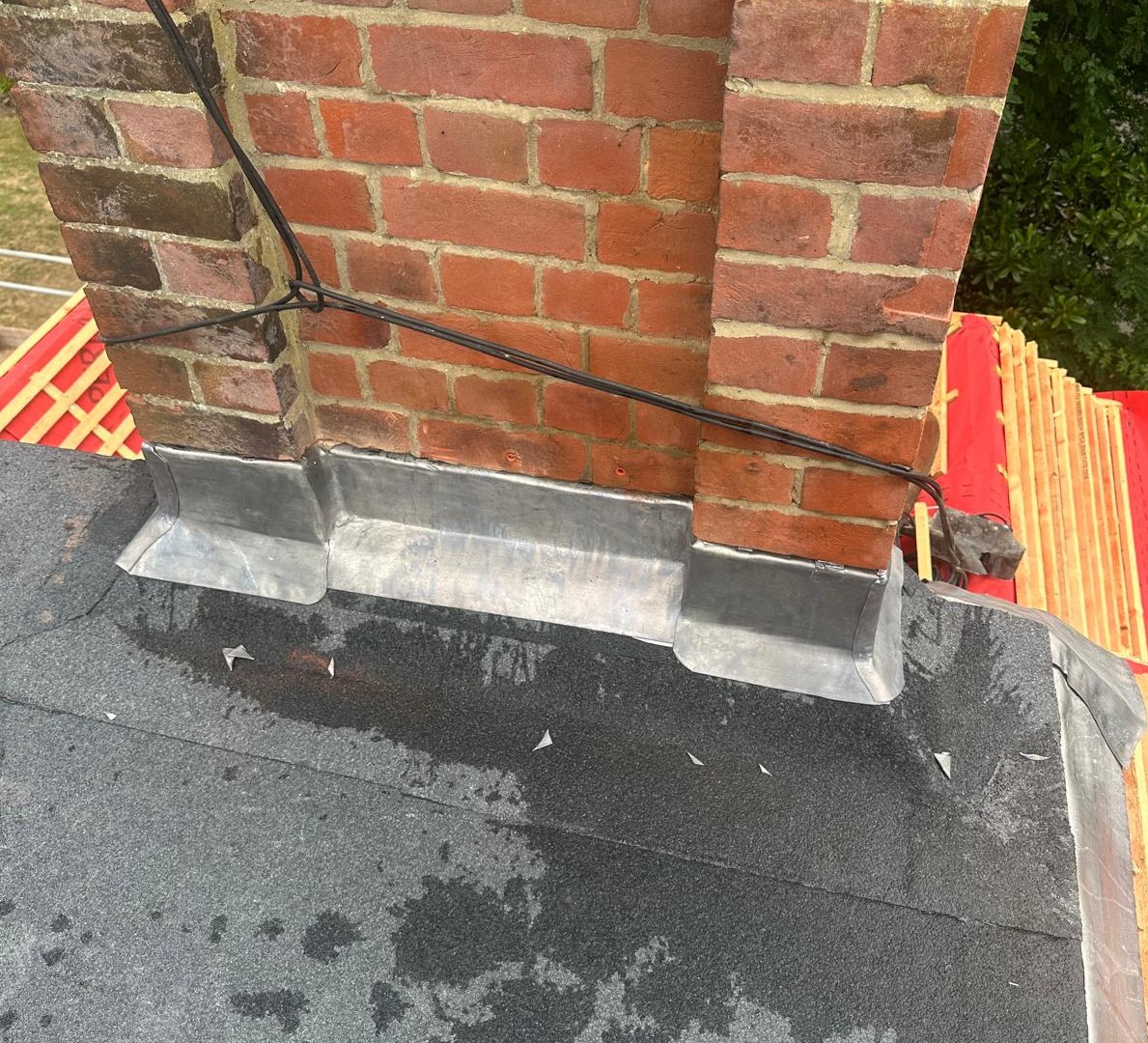
The lead work where a chimney stack passes through the roof is one of the most demanding details in residential roofing. The front apron deflects water down the slope, the step flashings track the courses of brickwork up the sides, and the back gutter behind the stack catches everything coming down the upper slope. Each piece sized, dressed and fixed correctly. For full chimney repointing, flaunching and rebuild work, see our dedicated Chimney Repairs page.
Valley Flashing
Valleys are where two slopes meet at an internal angle, and they take more water than any other part of the roof. Traditional lined valleys are dressed in Code 5 lead, supported on tilting fillets, with the tiles or slates cut and fitted neatly to the valley centre line. Modern alternatives like GRP valley troughs are also available where appropriate. We work with both, and we'll recommend honestly based on the property and the budget.
Step Flashing
Where a pitched roof slope meets a vertical wall, typically along the side of a chimney, a parapet wall or where an extension butts up to the original house, the flashing has to step down with each course of brickwork or stone. Step flashings are individually cut and dressed, with their upper edges chased into the brickwork joints and pointed back in. Done properly they last fifty years or more.
Apron Flashing
An apron is a single piece of lead that runs horizontally across the top of an abutment, deflecting water away from the joint and onto the tiles below. Used on the front faces of chimney stacks, at the bottom of dormer cheeks, around skylights, and anywhere a roof meets a vertical surface horizontally. The apron has to be sized correctly for the pitch, with the right amount of overhang and the upper edge properly fixed.
Skylight Flashing
Modern Velux and Fakro skylights come with manufacturer-supplied flashing kits sized to specific roof coverings (slate, plain tile, profiled tile, flat roof). We fit those kits according to the manufacturer's spec, which is the right approach because it preserves the warranty. For older fixed rooflights, bespoke skylights and unusual installations, hand-dressed lead is still the answer, and we'll detail that traditionally where called for.
Back Gutter Lead Work
The back gutter sits behind a chimney stack on the upper slope side, catching water that would otherwise pool against the masonry. It's an awkward detail to get right because water has to be deflected sideways onto the tiles either side of the stack without ponding or backing up against the brickwork. Properly formed back gutters are one of the marks of a roofer who knows what they're doing.
Dormer Window Lead Work
Dormer windows have a roof of their own, two cheeks rising up from the main roof slope, and a top junction where the dormer meets the main roof. Every join needs flashing. Side cheeks get apron flashings or step flashings depending on whether they meet a vertical face or a sloped face. Top abutments get aprons or back gutters. Tops of flat-roofed dormers need their own waterproof finish. We detail all of it in Code 4 and Code 5 lead, dressed by hand.
Lead Roof Repairs
Lead repairs are the day-to-day reality of older houses. Hairline splits in tired lead, lifted edges where fixings have given up, failed welts on long runs, joints opening up on chimney saddles. Most lead can be repaired or re-dressed rather than replaced wholesale. We patch with matching code lead, re-form failed sections, and only recommend full replacement when the existing lead has genuinely run out of life. For broader repair diagnostics, see our Roof Repairs page.
Our Services
Roof Leak Around a Chimney or Wall?
Most chimney-area and wall-junction leaks come down to failed lead work rather than the roof covering itself. Book a free survey and we’ll get up there, find what’s actually wrong and tell you straight.
Get the Lead Work Right and Forget About It
Properly fitted Code 4 and Code 5 lead has a working life of fifty years or more. That’s longer than most pitched roof coverings last. The difference between lead that performs that way and lead that fails inside a decade is almost entirely down to who fitted it and how. Sized correctly, dressed properly, fixed without restricting thermal movement, pointed back in cleanly. Nothing fancy, just done properly.
Get in touch for a free, no-obligation survey. We’ll look at the existing lead work, identify what needs attention and give you a written quote covering scope, materials and finish.
Guarantees You Can Actually Rely On
Every lead work and flashing job we carry out is backed three ways:
Written Workmanship Guarantee
You'll get a written guarantee specific to the work carried out. Section repairs and re-dressing typically carry several years of cover. Full re-flashing and major lead work on chimneys, valleys and dormers carry substantial long-term workmanship guarantees.
Insurance-Backed via CORC
Confederation of Roofing Contractors membership means our guarantees are insurance-backed by the scheme. If for any reason MGP Roofing couldn't honour a guarantee ourselves, the underwriter steps in. That's a level of protection most lead specialists simply can't offer.
£10 Million Public Liability
Every job, no matter the size, is fully covered by our £10 million public liability insurance. Working at lead-flashing height is genuine roof-edge work, and proper insurance is non-negotiable.
F. A. Q
Frequently Asked Questions
Common questions homeowners ask us about lead work and flashing. If yours isn’t here, give us a ring on 07304 092761 and we’ll talk it through.
The code number refers to the thickness of the lead sheet. Code 4 is approximately 1.80mm thick and used for most flashing applications including aprons, step flashings, soakers and chimney details. Code 5 is approximately 2.24mm thick and used where the lead takes more punishment, including valley linings and back gutters. We use the right code for the job, never under-spec to save material costs.
Code 4 and Code 5 lead, fitted correctly with proper sizing, fixings and detailing, has a working life of 50 years or more. The lead itself can easily last twice that. The bits that fail first are usually the fixings, the pointing where the lead is chased into brickwork, or the joints where one piece overlaps another. All of those are repairable without replacing the whole flashing.
There are alternatives to lead, and we'll fit them where they suit the job. Modern lead-replacement materials like Ubbink Ubiflex or Rolflash work well in some applications and have a place. They cost less in materials and fit faster. Where they don't perform as well as lead is on long-life detailing of chimneys, valleys and major abutments. We'll recommend honestly. For a small repair on a low-importance detail, an alternative may be the sensible choice. For a chimney that needs to last another fifty years, lead is still the right answer.
Lead splits primarily for two reasons. First, sections that are too long are not allowed to expand and contract through hot summers and cold winters. The lead works itself to death trying to move. Second, lead nailed solid along its length rather than fixed only at one edge has nowhere to go. Properly sized sections (typically no longer than 1.5 metres) and correct fixing technique prevent both. When we replace split lead, we replace it with something that won't split for the same reason.
Most lead can be patched or re-dressed rather than wholesale replaced. We solder or weld new lead onto sound existing material, re-form failed welts, re-point edges into brickwork, and replace only the sections genuinely past saving. Whole-flashing replacement is sometimes needed, especially where the lead has been butchered by previous repairs, but it's not the default. We'll always quote for the genuine scope.
Yes. Lead on roofs is fully encapsulated above living spaces and presents no health risk to occupants. Concerns about lead are about ingestion (paints, plumbing in older properties) rather than weathered lead flashings sitting on the outside of the building. Lead is also fully recyclable, with old lead routinely melted down and re-used, which makes it one of the more sustainable building materials available.
Yes. £10 million public liability insurance covers every lead and flashing job we do, from a single soaker to full chimney re-flashing. A copy of the certificate can be provided with your quote.
What We Use :