
- Tile & Slate Roofs
Tile & Slate Roofs
Specialist tile and slate roofing for homes across Hampshire, Dorset and Surrey. From period properties needing reclaimed materials to modern homes in crisp natural slate, we know how to match, source and lay every roof covering the British climate can throw at us.
The Right Tile or Slate Makes All the Difference
Not all pitched roof coverings are equal. A Georgian cottage finished in budget concrete interlocking tiles looks wrong in ways you can’t quite put your finger on, even if every tile is technically laid correctly. A modern townhouse dressed in heavy natural slate looks imposing and permanent. Matching the covering to the property is half the craft of being a proper tiler.
Beyond aesthetics, the material you choose determines how your roof behaves. Natural slate can last a hundred years or more with almost no attention. Clay tiles weather beautifully and gain character with age. Concrete interlocking tiles are a workhorse option that offers excellent value. Reclaimed materials carry a patina that brand new ones take generations to develop. We’re happy to work with all of them, and we’ll give you honest advice on which genuinely suits your property rather than pushing whichever brings us the best margin.
We’ve been laying tile and slate roofs across the South of England for over twenty years. We know which suppliers carry what, which quarries produce which grades, where to source reclaimed stock that actually matches, and how to lay each material to last the way it was designed to.

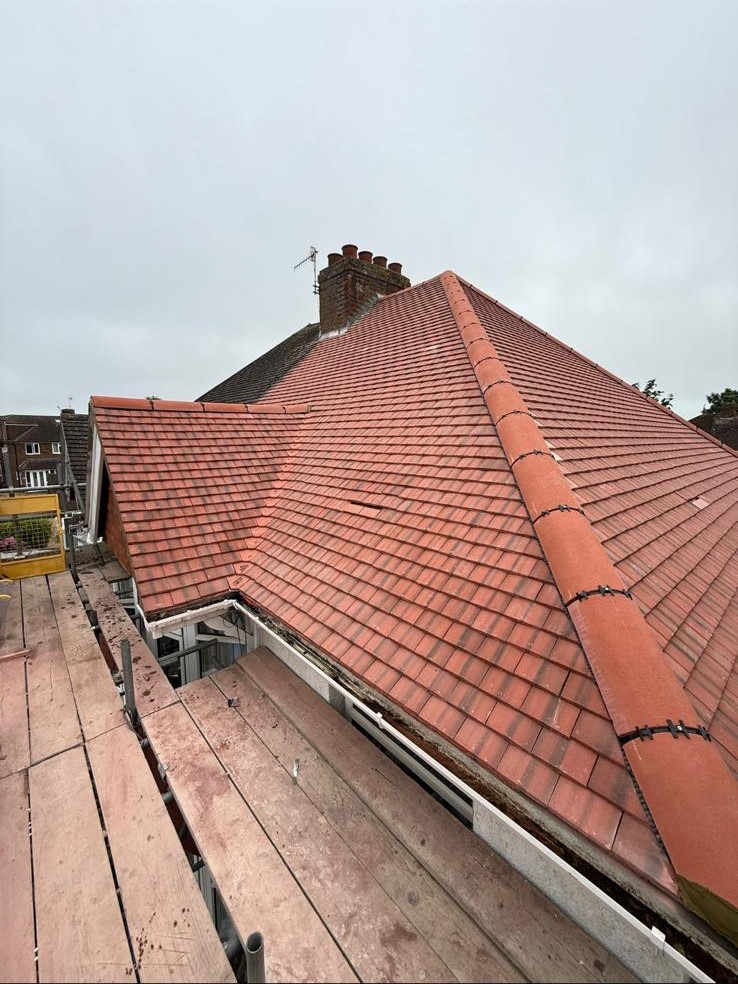
Our Tile & Slate Roofing Services
Tile Roof Repairs
Clay and concrete tiles fail in characteristic ways. Frost damage to exposed edges, lamination on cheaper concrete, cracks radiating from nail holes, and broken corners where someone's been up for a previous repair. We match replacements to your existing tile profile, colour and weathering, working with current stock where possible and salvaged stock when a tile has been discontinued. For our full roof repair methodology and diagnostic approach, see our Roof Repairs page.
Slate Roof Repairs
Slate problems are different to tile problems. The slate itself rarely fails, but the iron nails holding it up do, which is why older slate roofs shed slates one by one once the fixings pass their useful life. This is traditionally called nail sickness. We replace slipped and cracked slates, re-fix loose ones with copper slate hooks where re-nailing isn't practical, and match natural slate replacements carefully by thickness, colour and source. More on our general repair process is on the Roof Repairs page.
New Tile Roof Installation
Tile choice is where we spend most of the planning time on a new tile roof. Clay plain tiles suit period properties and small-scale detailing. Clay pantiles bring the instantly recognisable rolling curves of traditional South coast architecture. Concrete interlocking tiles cover larger roof areas quickly and economically. We'll walk you through the aesthetic, weight, pitch requirements and longevity of each, then source the right tile from the right manufacturer for your project.
New Slate Roof Installation
Natural slate is the gold standard of British roofing, and for good reason. It can easily outlast its own homeowner and a couple of their successors. We lay Welsh slate (the traditional choice, near-unbeatable in colour and durability), Spanish slate (the most widely specified in modern roofing, excellent quality at a more accessible price point) and Brazilian slate (visually distinctive, often used for contemporary designs). Each has its own working characteristics, and each is laid slightly differently.
Ridge Tile Repointing & Rebedding
Mortared ridges and hips crack and loosen over time because mortar and tile expand and contract at different rates through every hot summer and cold winter. Repointing means raking out the failing mortar and filling the joints fresh. Rebedding means lifting the ridge tiles, re-laying the whole run on new mortar with a proper haunching, and re-pointing the joints. Both are done by hand and both buy a traditional mortared ridge another couple of decades. For a permanent mechanical upgrade, see our Dry Ridge / Dry Verge page.
Broken & Missing Tile Replacement
After a storm, after a chimney sweep's clumsy exit, or sometimes just after a dense buildup of moss has finally let go, you often end up with a handful of broken tiles and gaps on the slope. Quick work keeps water out, but matching the replacement matters. We keep a stock of common current tiles in the van for immediate repairs, and if your tile has been discontinued we track down weathered salvaged stock or, where necessary, discreetly swap tiles from a less visible slope. Full repair diagnostics are on our Roof Repairs page.
Concrete, Clay & Interlocking Tiles
We stock, source and lay the full range of modern tile types. Concrete plain tiles are the budget-friendly traditional look, ideal for smaller roof areas. Concrete interlocking tiles are the big-area workhorses, fast to lay and long-lasting. Clay plain tiles deliver the small-unit traditional aesthetic, suited to period properties and detail-heavy roofs. Clay pantiles and clay interlocking tiles bring character that concrete can't match. We work with the major UK manufacturers including Marley, Redland, Sandtoft, Russell and Dreadnought.
Reclaimed & Heritage Slate
Period properties, conservation areas and listed buildings often require reclaimed or salvaged slate to keep the roof visually correct. Newly quarried Welsh slate looks unmistakably new next to hundred-year-old slate, and planning officers notice. We have established relationships with specialist reclamation yards and can source genuine weathered Welsh slate, second-use Spanish slate and heritage clay tiles that will blend properly with what's already on the roof. Sourcing the right materials is often the longest part of this type of job, and we take the time to get it right.
Our Services
Not Sure What's on Your Roof?
Most homeowners aren’t sure whether they’ve got natural slate or fibre-cement, clay or concrete, modern or heritage. Book a free survey and we’ll identify what you’ve got, explain what your options are and give you an honest written quote.
A Roof That Looks Right Is Worth the Time to Get Right
Choosing the right tile or slate for your home isn’t a decision to rush. Different materials suit different architectural styles, different weight tolerances, different pitches and different budgets. We take the time to show you options in person, explain the trade-offs properly and give you a written quote covering materials, labour and every detail in between.
Get in touch for a free, no-obligation survey. We’ll come out when it suits you, climb up for a proper look, and talk you through what would work best.
Backed by Three Layers of Guarantee
Every tile and slate roof we install or restore comes with proper protection built in:
Written Workmanship Guarantee
Full new tile and slate roofs carry our 20-year workmanship guarantee, in writing, from day one. Smaller repair and re-pointing work carries appropriate written cover specific to the scope.
Insurance-Backed via CORC
Confederation of Roofing Contractors membership means our guarantees are underwritten by the CORC scheme. If for any reason we couldn't honour a guarantee ourselves, the insurer steps in.
Manufacturer Material Warranties
Your tiles, slates, fixings and membranes all come with their own manufacturer warranties, independent of our workmanship cover. Natural slate typically carries lifetime warranties. Major tile manufacturers offer 30+ years on their current product lines.
F. A. Q
Frequently Asked Questions
Common questions homeowners ask us about tile and slate roofing. If yours isn’t covered below, give us a ring on 07304 092761 and we’ll talk it through.
Natural slate is heavy, slightly irregular in thickness, and usually has visible grain or cleavage lines across its surface. Fibre-cement slate alternatives are noticeably lighter, perfectly uniform in thickness, and have a machined edge that looks too clean. From ground level they can look similar, but up close the difference is obvious. A quick survey will tell you what you've actually got.
Usually, yes. We work with specialist reclamation yards and salvage merchants who stock discontinued tiles, and for common older products we can often track down weathered stock that blends in properly. If exact matching isn't possible, we'll sometimes swap tiles from less visible parts of your roof (back slopes, lower edges) to the front and use the new stock where it matters less. Discreet, practical, and it works.
A properly laid Welsh slate roof, with copper nails and good ventilation beneath, can easily last a hundred years. Spanish slate typically 80 to 100 years. Brazilian slate 60 to 80 years. In all three cases, the fixings usually fail before the slate itself, which is why older slate roofs often just need re-fixing rather than replacing.
Sometimes, depending on the condition of the tiles and whether there are enough sound ones to cover the roof. We salvage and re-use wherever it's practical, especially on period properties where original tiles carry a character that replacements can't match. We'll assess honestly during the survey, and never charge for new materials where salvage is the better approach.alth of historic and listed properties, particularly around Stroud, Cheltenham and the Cotswolds, and we have experience working sensitively on older buildings where material choices and methods need to meet specific requirements. We're always happy to advise on the best approach for your property.
Plain tiles are small, flat units laid in overlapping double-lap courses, giving the fine-grained traditional look you see on period properties. Interlocking tiles are larger single-lap units with a profiled edge that interlocks with its neighbour, allowing faster coverage of larger roof areas. Both have their place. Plain tiles suit older, smaller-scale properties. Interlocking suits modern homes and larger roof areas where plain tiling would be labour-intensive and expensive.
Yes. Listed building and conservation work generally requires careful material matching, traditional techniques and sensitivity to the building's history. We source reclaimed and heritage materials, use traditional fixing methods where appropriate, and are happy to liaise with conservation officers and planning authorities when the job calls for it.
Yes. £10 million public liability insurance on every job, regardless of size. A copy of the certificate can be included with your quote.
What We Use :